Skip to content

Salt Marsh Science Project Celebrated 20th Anniversary

No Close
1. Massachusetts Environmental Trust Grants (FY2016) includes partner project in Boxford
2. Stream Continuity and Infrastructure Assessment Project Update
3. Great Marsh Awarded Federal Wetlands Grant
4. Marsh Adaptation Strategy Tool (MAST)
5. King Tides and Sea Level Rise
6. MyCoast Tracks Coastal Storms
7. PIE Rivers Annual Meeting Promotes the Power of Partnerships
8. New Flooding and Sea Level Rise Maps Aid Resiliency Planning Efforts
9. Essex Tech Students Study Plum Island Beach Movement
10. COAST Analysis of Newburyport
11. Planning Partners Report Progress
12. Ipswich River Re-opens to Shellfishing
13. Partners remove over 600 tires during “Turtle Land” cleanup
14. Greenbelt One Step Closer to Protecting Leonhard-Eldred Farm
15. Native Plantings and Sand Fencing Help Beach Dune Restoration
16. Improved fish ladder proposed for Willowdale Dam
17. Dune Resiliency Efforts on Salisbury Beaches
18. EPA Releases Stormwater Permit
19. Greenbelt Steps Closer to Conserving Sagamore Hill
20. Ipswich High Students Explore Sea Level Rise
21. PIE-Rivers Partners Gather for Great Marsh Resiliency Modeling Workshop
22. Communities Plan for Living Shorelines
23. Local Students Give Presentations on Sea Level Rise and Storm Surge Impacts
24. Partner efforts help river herring upstream
25. Communities Take Action on Resiliency
26. Survey Work Begins at Ipswich Mills Dam
27. Town of Ipswich Receives Coastal Resiliency Grant
28. Ipswich Dam Team Visits Exeter Restoration Project
29. Nanotags: Understanding large landscape connections using nano-technology
30. Coastal Resiliency Planning Project Works on Solutions
31. PIE-Rivers Partnership Annual Meeting 2016
32. Great Marsh Sea Level Rise Symposium: Implications for Quality of Life in Our Communities
33. Greenbelt Hosts Inaugural Essex County Open Space Conference
34. Salt Marsh Science Project Celebrated 20th Anniversary
35. 2016 PIE-Rivers Annual Meeting
36. EPA Releases Dam Removal FAQ
37. Choate Island Forest Clearing Project
38. Partners Protect Castle Neck Headwaters
39. Wenham and Boxford receive DER assistance to upgrade degraded culverts
40. PIE-Rivers Partnership Annual Meeting 2017
41. PIE-Rivers Partners Celebrate 2017 Accomplishments
42. The Great Marsh Coastal Adaptation Plan Is Now Online

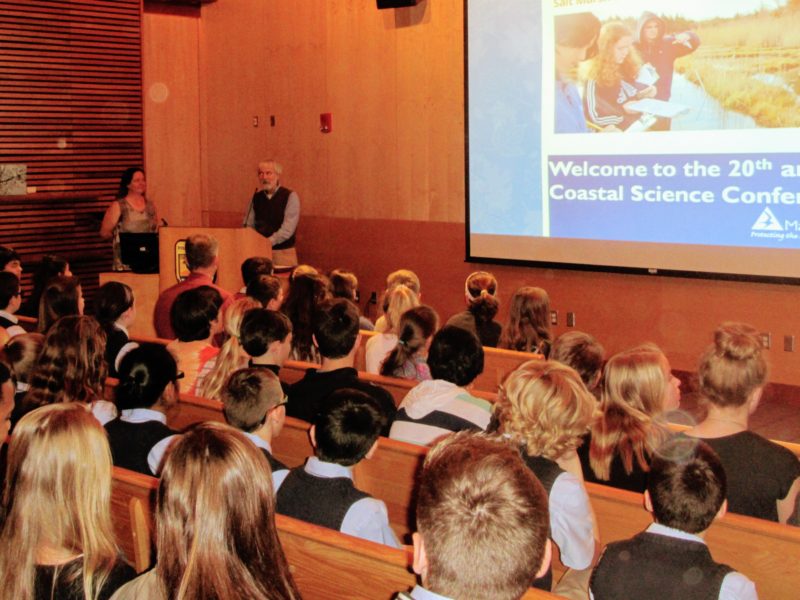
In November 2016, 140 students, teachers, and professional scientists gathered for the annual Coastal Science Conference at the Parker River National Wildlife Refuge in Newburyport to share the latest findings from Mass Audubon’s Salt Marsh Science Project, and to celebrate the project’s important work over the past 20 years. The annual conference, organized by Education Coordinator, Liz Duff, of Mass Audubon, serves as the culmination of a season of student work.  Students learn important science concepts while contributing to the conservation of important local ecosystems. The focus of students’ research is on the invasive reed, Phragmites.

Twenty years has accumulated some amazing tallies. Nearly 20,000 students and more than 200 teachers from 30 communities have participated in this project.  Each school has monitored its own study site in towns from the Merrimack Valley to Cape Cod.  In that time, tidal flow has been restored to 12 of the 23 sites, improving the health of more than 50 acres of salt marsh.

Students shared the results of this year’s field experiences with presentations and poster displays. For students who have dedicated their efforts to studying their local marsh, this conference is an opportunity to see how their efforts are connected to the work of other students and other sites, and the larger context of efforts to protect and restore Massachusetts’ salt marshes.

“It’s exciting to see this project in its 20th year.  It has become an integral part of local schools’ curriculum as new teachers pick up where retiring teachers have left off,” said Mass Audubon’s Liz Duff, coordinator of the Salt Marsh Science Project and conference organizer. “There is a lot of excitement generated among the students when they meet their peers and professional scientists and learn from their work at this conference.”

Comments (0)

Leave a Reply

Your email address will not be published. Required fields are marked *

Back To Top